
German Messerschmitt Bf 109 Gustav fighter plane.
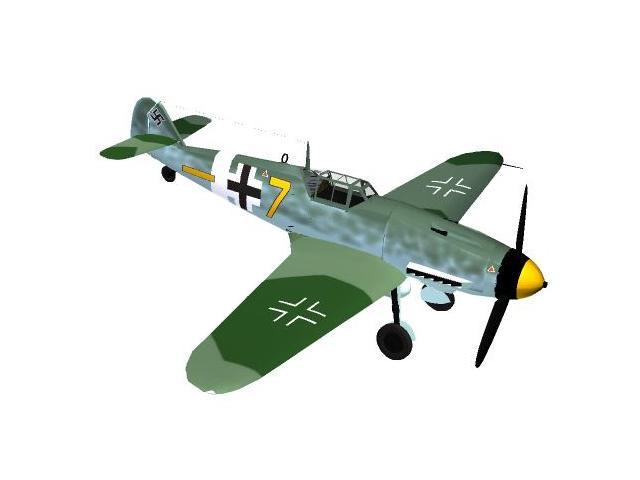
History, development, service, specifications, pictures and 3D model of the main version of the Me 109.

Messerschmitt Bf 109 G (‘Gustav’)
Messerschmitt Bf 109 G
Type: German Luftwaffe single-seat fighter.
The Messerschmitt Bf 109G, commonly known as the “Gustav”, was one of the most widely produced and important variants of the famous German Bf 109 fighter aircraft used during World War II. It represented a major evolution from earlier versions (like the F series), incorporating more powerful engines, heavier armament, and various field modifications to meet changing combat needs.
Overview
– Full designation: Messerschmitt Bf 109G
– Nickname: Gustav
– Role: Fighter / Interceptor / Fighter-bomber / Reconnaissance
– Manufacturer: Messerschmitt AG
– First flight (G variant): 1942
– Entered service: Mid-1942
Technical Specifications (typical Bf 109G-6)
– Engine: Daimler-Benz DB 605A-1, liquid-cooled inverted V12
– Power output: ~1,475 hp (1,100 kW)
– Maximum speed: ~640 km/h (398 mph) at 6,600 m (21,650 ft)
– Range: ~850 km (528 miles)
– Service ceiling: ~12,000 m (39,400 ft)
– Rate of climb: ~17 m/s (3,350 ft/min)
Armament (varied by sub-variant)
Standard:
– 1 × 20 mm MG 151/20 cannon firing through the propeller hub
– 2 × 13 mm MG 131 machine guns above the engine
Optional / field kits:
– Underwing 20 mm or 30 mm cannon pods (Rüstsätze kits)
– Bombs (up to 500 kg) for fighter-bomber missions
– Reconnaissance cameras (in G-8 variant)
Notable Sub-Variants
– Bf 109G-1 / G-2: Early pressurized and non-pressurized high-altitude fighters.
– Bf 109G-4: Improved radio and landing gear.
– Bf 109G-6: Most produced variant; introduced the MG 131 heavy machine guns (bulged cowling gave it the “beule” look).
– Bf 109G-10 / G-14: Late-war versions with refined aerodynamics and DB 605D engines for better performance.
Operational History
The Gustav served on all fronts:
– Eastern Front: Dogfights against Soviet Yak and La fighters.
– Western Front: Intercepting Allied bombers and escorting missions.
– Mediterranean and North Africa: Used by the Luftwaffe and Axis allies.
It was flown by many of Germany’s top aces, including Erich Hartmann, the highest-scoring fighter ace in history.
Legacy
The Bf 109G was among the most produced fighter aircraft of WWII, with over 23,000 Gustavs built. Although later outperformed by newer Allied fighters like the P-51 Mustang and Spitfire Mk IX, the Bf 109G remained a formidable opponent until the end of the war.
History
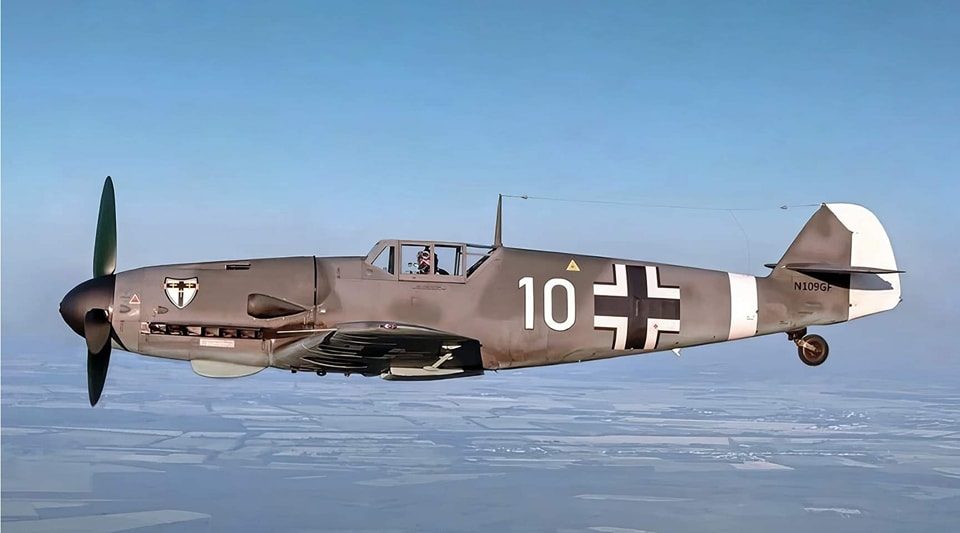
The wartime requirement for greater power in single-seat fighters, especially after the Battle of Britain, led to the development in the early summer of 1942 the Me 109 G with the more powerful DB 605 A engine. With a take-off power of 1,475 hp, this engine gave the ‘Gustav’ a speed of about 650 km/h at a height of 6,000 meters. The new airframe featured a stronger undercarriage, a larger oil-tank, the previously available pressurized cockpit, provision for fitting the GM-1 nitrous oxide injection system, rear armor and head protection for the pilot, and roller-bearing-mounted slats. It could also be fitted with a bomb-rack or drop-tank.
As early as the autumn of 1941 a zero-series of several models was tested with the DB 601 E engine. The Bf 109 G-1 was conceived as a single-seat high-altitude fighter with a pressurized cabin. The aircraft went to II/JG1, and later a few went to II/JG26 as equipment for high-altitude squadrons. At the end of 1942 they first saw action in the Mediterranean.
Series production of the Me 109 G-2 without the pressurized cabin began in parallel production of the Me 109 G-1, and G-2 aircraft were supplied in the summer of 1942 to, among others, Jagdgeschwader JG 2, 3, 5,27, 62, 53, 54 and 66, as well as different reconnaissance groups.
Next came the Me 109 G-3, which was the second ‘Gustav’ to have a pressurized cockpit. From 1943 this type was used in small numbers by high-altitude squadrons and by Reserve Fighter Group West. From May 1943 fitting of the GN-1 injection system began.
By August 1942 the Me 109 G-4 was being produced in considerable numbers and this version went into active service in November.
The Me 109 G-5 was the last of the series to be built as high-altitude fighters with pressurized cockpit. With the introduction of the more powerful Me 109 G-6, the G-5 had only limited application in the fighter groups.

In February 1943 the Me 109 G-6 was introduced and from then until the summer of 1944 was produced in large numbers to become a major component of national defense. The first aircraft of this series differed only slightly from the G-4, the two MG17s mounted above the engine being replaced by MG131s. It had not been possible to accommodate an ammunition supply within previous engine cowling designs, but from the G-6 typical bulges were incorporated for this purpose on both sides of the forward fuselage.
To improve pilot safety, the aircraft were fitted from 1943 with the so-called ‘Galland Armour’ with armored glass, and somewhat later, with the ‘Erla Canopy’ or sometimes called ‘Galland Canopy‘. Further modifications consisted of a partial removal of the radio aerial behind the cockpit. In the early months of 1944 an increasing number of Bf 109 G-6s had larger fins with an integrated servo-rudder.
To increase engine power at greater heights, the DB 605 AS was introduced in early 1944; this was a DB 605 A engine with more powerful supercharger of the DB 603. As the engine was considerably larger, the cowling of the Bf 109 G/AS was completely modified. At the same time the ammunition supply for the MG131 was streamlined, and a new propeller was introduced. The first of this more powerful aircraft were introduced at the beginning of 1944 in III/JG1 and I/JG5. Part of the older series was re-equipped to AS standard.
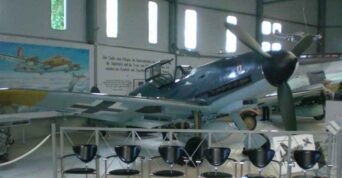
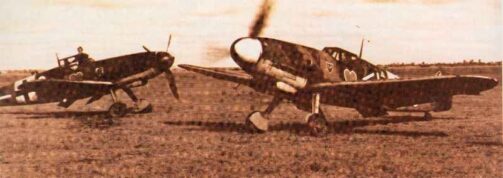
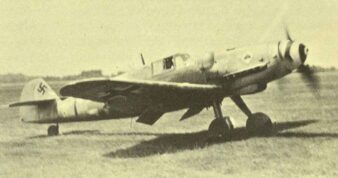
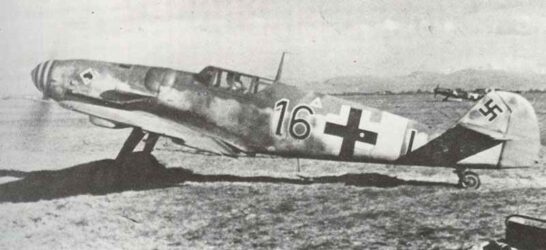
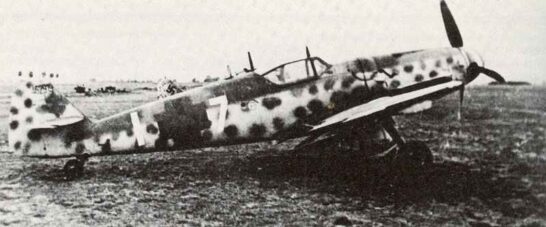
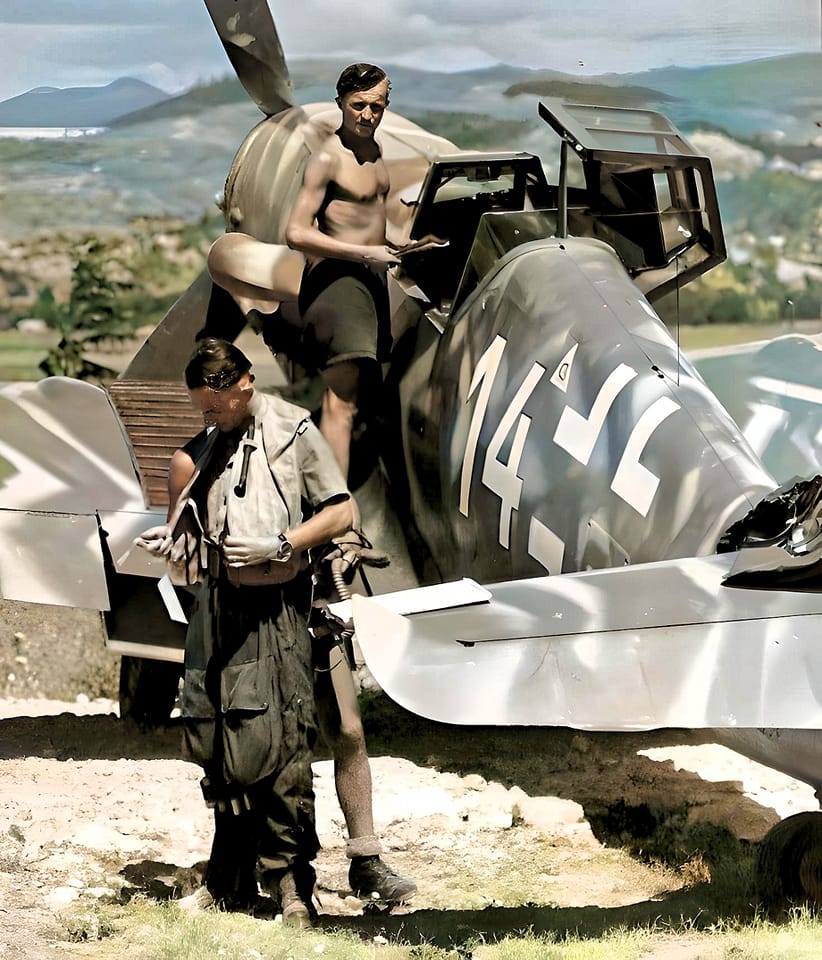
The G-10 was often used as escort and high-cover for Fw 190 fighter-bombers, which were increasingly being equipped ‘Panzerblitz’ and Panzerschreck anti-tank missiles.
From the middle of 1944 some 145 older Me 109 G-2, G-3, G-4 and G-6 aircraft were rebuilt as Bf 109 G-12 two-seat trainers, mainly by Blohm&Voss.
The G-14 was the last model in the G-Series. The first aircraft were supplied to JG 4, 76 and 77 in France in June 1944, and later to virtually all Jagdgeschwader. Among others, they were supplied as replacements to Kampfgeschwader I/KG(J)6, I/KG(J)27 and II/KG(J)30, as well as to the first two groups of KG(J)55. Some of this type also went to NJG11 and NAG 1,2,3,4 and 14.
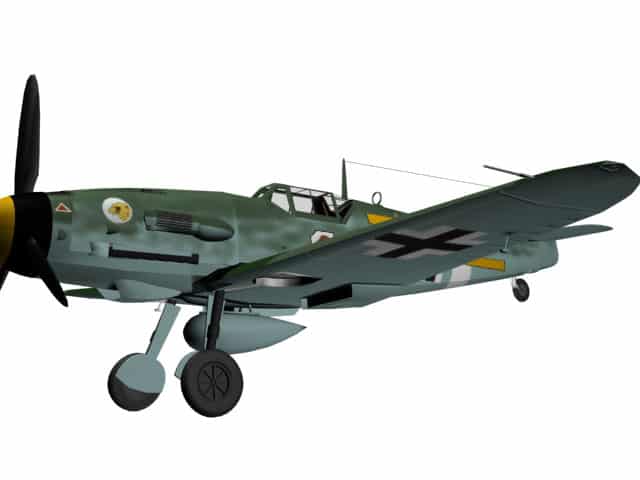
Animated 3D model Messerschmitt Bf 109 G-2/Trop
Specifications Messerschmitt Bf 109 G-2
Specifications:
Bf 109 G-2 | Specification |
|---|---|
Type | Single-seat fighter |
Power plant | 1 x 1,475 PS DB 605A-1 |
Accommodation | 1 |
Wing span | 32 6.7 ft |
Length overall | 29 ft 0.3 in |
Height overall | 10 ft 6 in |
Wing area | 174.38 sq ft |
Weight empty | 5,897 lb |
Weight loaded | 6,940 lb |
Max wing loading | 39.82 lb/sq ft |
Max power loading | 4.70 lb/hp |
Max level speed | 386 mph (at 22,660 ft) |
Cruising speed | 311 mph (at 19,685 ft) |
Initial climb | c. 3,500 ft/min. |
Time to height | 16,405 ft in c. 5.0 min |
Service ceiling | 38,000 ft |
Range | c. 621 miles |
Armament:
Bf 109 G-2 | Specification |
|---|---|
through propeller hub | 20-mm MG151/20 (720 rpm; velocity 1,920 ft.sec) |
above engine | 2 x 7.92-mm MG17 (1,200 rpm; velocity 2,477 ft.sec) |
Service statistics:
Bf 109 G-2 | figures |
|---|---|
Production delivery | May 1942 |
First combat mission | summer of 1942 |
Final delivery (all variants) | May 1945 (Germany) |
Price per unit | RM 100,000 = c. $ 45,000 = c. £ 11,250 |
Total production figure (all variants) | 35,000+ (30,480 during WW2) |
Accepted by Luftwaffe 1/39-12/44 | 29,350 |
Production 1939 | 449 |
Production 1940 | 1,693 |
Production 1941 | 2,764 |
Production 1942 | 2,665 |
Production 1943 | 6,154 |
Production 1944 | 13,786 |
Production 1945 | 2,969 |
Me 109's in First Line Units 1.9.39 | 1,085 |
Me 109's in First Line Units 20.9.42 | 1,074 |
Me 109's in First Line Units 31.12.42 | 700 (of these 610 G models) |
Me 109's in First Line Units 10.1.45 | 1,305 |
References and literature
German Aircraft of World War 2 in Colour (Kenneth Munson)
Warplanes of the Luftwaffe (David Donald)
The Luftwaffe Album, Bomber and Fighter Aircraft of the German Air Force 1933-1945 (Joachim Dressel, Manfred Griehl)
Luftwaffe Handbook (Dr Alfred Price)
Messerschmitt Bf 109F-G in Luftwaffe & Foreign Service (Aircam Aviation Series No 40)
Combat Aircraft of World War II (Bill Gunston)
Technik und Einsatz der Kampfflugzeuge vom 1. Weltkrieg bis heute (Ian Parsons)
Das große Buch der Luftkämpfe (Ian Parsons)
Luftkrieg (Piekalkiewicz)
Flugzeuge des 2. Weltkrieges (Andrew Kershaw)
The Encyclopedia of Weapons of World War II (Chris Bishop)